THE STUDIO OF MEMORY

Before there was a camera in every pocket, a photograph in Kalimpong was usually made in a particular room. You might climb a narrow stair or step behind a shopfront at 10th Mile into a side room with a painted backdrop, a wooden stand to lean on, and a comb and mirror for last adjustments. The first commercial studio had opened by the turn of the twentieth century. By the 1940s studios had become a familiar part of the bazaar—Pushpa, Gopal, Om, Bharat, Rehman, SKG, Photo Palace and others, each with its own regulars, its own props and its own way of making people look their best.
The studio was a stage for self-fashioning. For much of the colonial period, the camera arrived in the Hills as an instrument of classification. It recorded people as “types,” measured against a dispassionate frame and filed for someone else’s knowledge. The studio offered something different, though never neutral. Here the sitter had a say. Tibetan traders posed in their boots and robes after weeks on the trail. Sitters arrived in their best clothes and jewellery and asked that a cherished ornament, a ring or a new wristwatch be caught by the lens. A necktie, a coat or a pair of goggles was kept behind the counter for anyone who wanted them. The studio also had its conventions of pose, prop and backdrop, and across Kalimpong’s many communities these shaped a shared visual language of poise, presence and possibilities.
We tend to think of old photographs as belonging to the past. But a studio portrait was always made with a future in mind. A family posed together before a child left for school, friends gathered before a graduation scattered them, and a couple sat for a photograph to mark a beginning. These images were made to be framed and hung, sent to relatives, carried across borders and looked at by people who were not yet in the room. In the studio, people did not simply record who they were. They presented who they hoped to be, and how they wished to be seen by those who would come after.
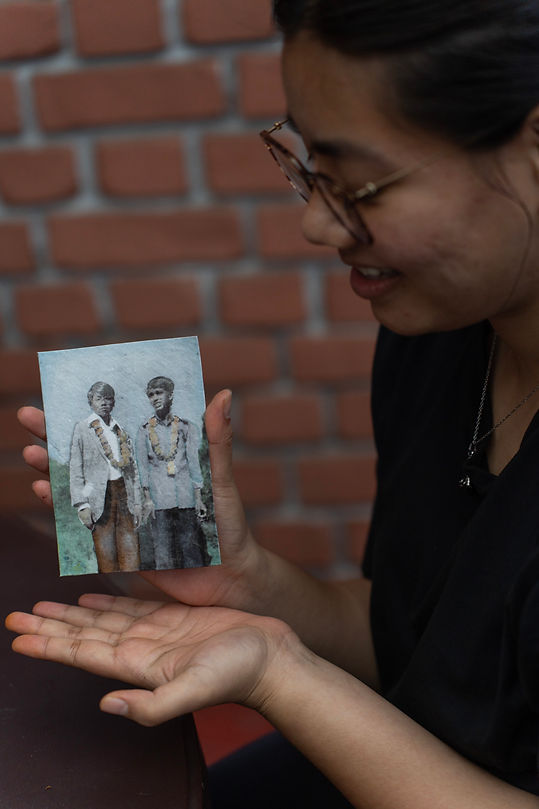
The studios were also social infrastructure. They stood on a trade route, and Tibetan was spoken across their counters. Prints of the Potala and portraits of His Holiness the Dalai Lama travelled back over the passes. Studios sold soda water on haat days and made advertising slides for the cinema halls. Their skills passed from hand to hand, and many studios can be traced through lines of apprenticeship. Pushpa Mani Pradhan learnt photography at the studio Lal Mohamad had founded near the Motor Stand. In the 1940s he opened Pushpa Studio at 10th Mile and took on apprentices of his own. Among them was Gopal Das Pradhan from Pedong, who set up Gopal Studio a short walk away in the mid-1950s. Darkroom work, negative retouching and hand-colouring were specialist skills within this network. Tinting a black-and-white bromide print by brush did not simply document a life. It imagined one, adding colour where film could not and bringing the picture closer to a world the sitter wished for.
Digital photography emptied the darkrooms, and most studios that remain now survive on passport photographs. Yet the images they produced endure in albums, drawers and studio archives, a rare snowfall, the first toy-train rides through the Sevoke jungles to Giele Khola, Independence Day parades, the work of Dr. Graham’s Homes. Together they form an intimate, unofficial history of the town, written largely by its own residents. They are still reaching the future they were made for, and they reach it each time someone opens an album and asks who is in the picture.
The Studio of Memory approaches the photo studio as a form of contemporary art practice rather than an object of nostalgia. Installed temporarily across several sites in Kalimpong, it reactivates the studio as a space for participation, recollection and experimentation. It is a place to sit and be photographed again, to bring and talk about old pictures, and to handle the material life of the photograph. Alongside the installation, a conversation with studio owners and a hand-colouring workshop with Purna Mani Pradhan, who still practises the technique used at his father’s Pushpa Studio, bring these working knowledges back into circulation. Memory here faces forward as much as back. It asks who held the camera, who decided how a person would be seen, and what we might want to say, now, to whoever looks at our photographs next.


Voigtländer Bessa folding medium-format camera, Kodak Studio
Photo: Ashwin Sharma
Display of old studio equipments at Rehman studio Photo: Brihat Rai
EXHIBITION
Photo, Studio and Memories
23-26th Oct, 2026 Kalimpong